
Jeddah Architectural Guide | CP/15
مكتب ديار السعودية – مبنى لوتس |
|
Lotus Building – Saudi Diyar Consultants |
|
| CORPORATE BUILDINGS/15 | |
| 1992 | Saudi Diyar Consultants/ Mohamad Hamouié |
| 21.45 m | 4 Storeys |
| 4,710 m² | 6,210 m² (Site) |

Planned in 1990 and completed in 1992, the Lotus Building is a four-storey office building located on a 6,210 sqm plot along Prince Sultan Road, north of Quraish Street. Originally designed as the head office of the Saudi Diyar Architecture & Engineering consulting firm, it is among the earliest examples in the city of architecture consciously attuned to context and environmental responsiveness. Today, the Lotus Building serves as the headquarters of the HUTA Group and its affiliated companies, leaders in engineering projects across Saudi Arabia and the wider region.
The following text is courtesy of the architect Mohamad Hamouié.
The building architect, Mohamad Hamouié, has pursued an approach to architecture that begins not with a blank slate, but with memory. Tradition is not treated as a motif to be borrowed or a style to be reproduced, but as a body of knowledge to be studied, absorbed, and transformed. Each project asks: what does the regional architecture already know? How can its forms, logics, and atmospheres be carried forward to meet present needs?
The Lotus Building, in Jeddah, epitomizes this method. Here, Mohamad Hamouié turned not to imported typologies, but to the vernacular fabric of Al Balad — to the ribat, a building form whose role in urban and social life was as vital as its architectural ingenuity. By returning to the ribat, he placed the project within a lineage of communal structures and reinterpreted it for a contemporary institution.

The Ribat: A Communal Archetype
In the historic quarters of Jeddah’s al-Balad, the ribat occupied a space between the house and the mosque. Though the term once described frontier fortresses, in the Hejaz it came to mean something more subtle: a hostel endowed for pilgrims, a refuge for widows and travelers, a place where communal care was given material form.
Architecturally, the ribat was both practical and simple. Its structure was of coral stone blocks, porous yet strong, bound in lime mortar. Rawāshin of teak screened the upper levels, filtering air and light, ensuring privacy while sustaining connection to the street. At its core, a courtyard offered not only circulation but also comfort. Passive environmental response was embedded in every element: thick walls that tempered heat, lattice screens that mediated sun and air, and courtyards that created microclimates.
To speak of the ribat is to speak of more than a typology. It was a building of clarity and purpose — modest in means, effective in performance — a communal architecture that provided comfort and protection with the simplest of resources.


Reinterpreting the Ribat
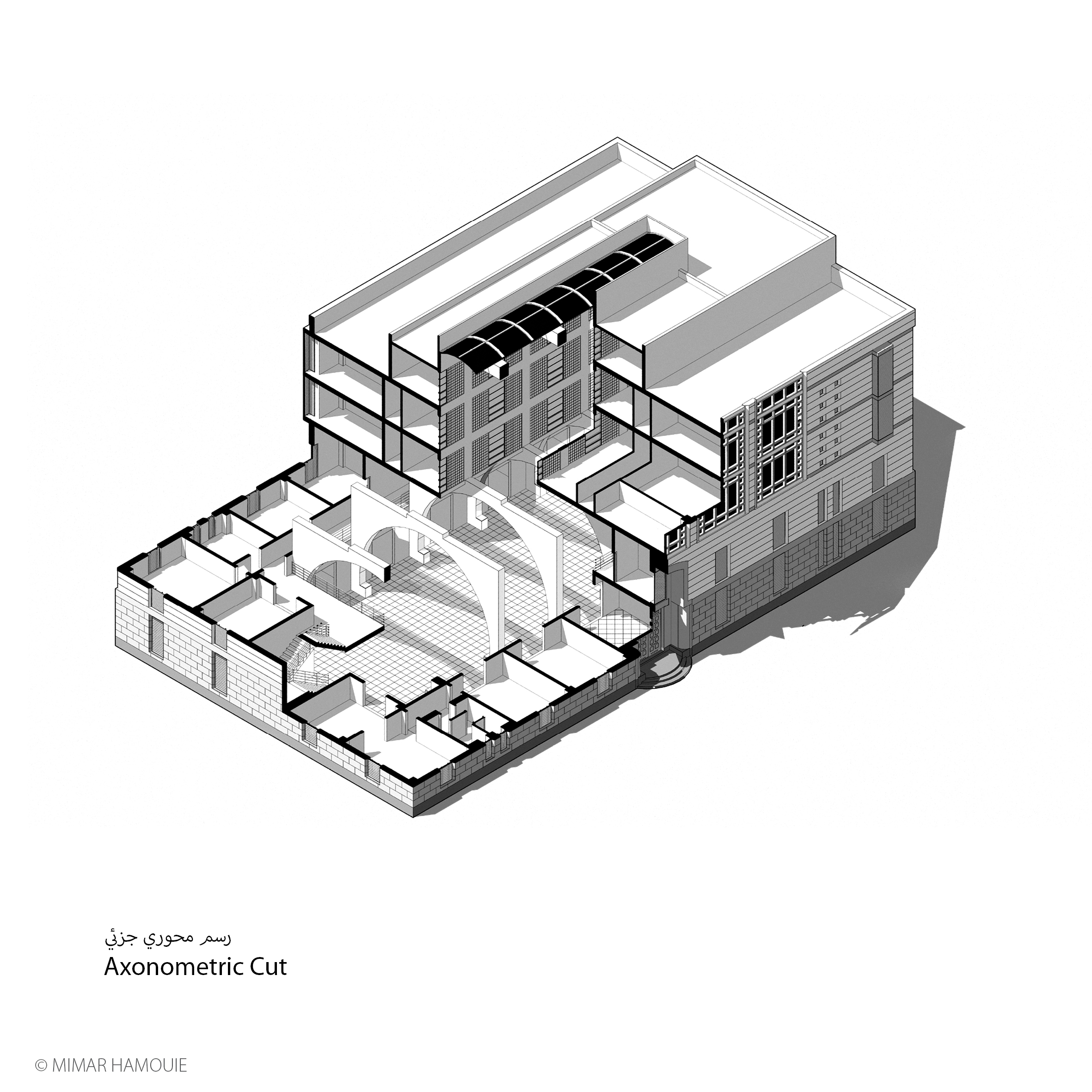
Hamouié did not replicate the ribat, but reinterpreted its principles for a modern institutional building. In plan, the Lotus Building inherits the ribat’s horizontality and clarity. A central atrium acts as a contemporary courtyard — regulating climate and serving as the building’s communal core — with offices arranged around its perimeter in a rational order.
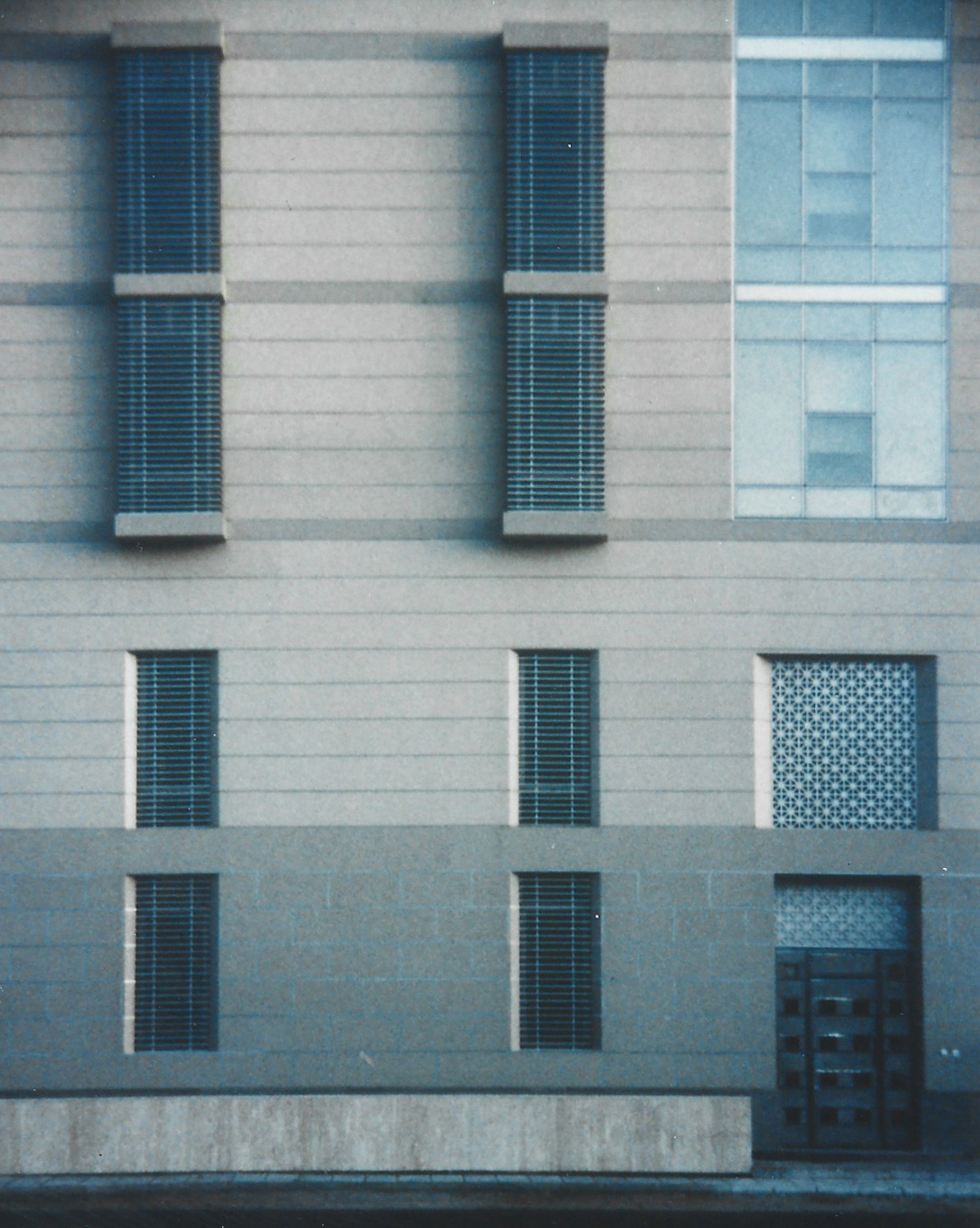
Externally, the massing is compact and disciplined, a cubic volume that recalls the ribat’s introverted solidity. The façades translate Jeddah’s traditional elements into a modern construction language. Both projecting rawāshin and flat rawāshin are employed, typical of al-Balad, but here they are recast in aluminum and glass rather than timber. Banded cladding fixed with aluminum U-channels produces horizontal reliefs, recalling the wooden takālil of Red Sea houses. Punched windows, lattice grilles, and shaded slots preserve the grammar of vernacular openings while rendered in contemporary expression.
At the entrance, Hamouié carried through the ribat analogy clearly. The portals of ribats were deep-set and layered, marking the transition from street to communal refuge. A granite arch frames the doorway with the same sense of depth and protection. Above, a patterned metal grille recalls the mashrabiya, filtering light while providing shade. The doors themselves replace Jeddah’s carved timber panels with stainless steel. This entrance ties the building back to the thresholds of the ribat while expressing its modern construction.

The Atrium as Courtyard
In the ribat, the courtyard was the essential space: it ordered circulation, brought air and light into the surrounding rooms, and created a comfortable communal center in a harsh climate. Thick walls protected it, while the void itself allowed for ventilation and relief from the city’s density.
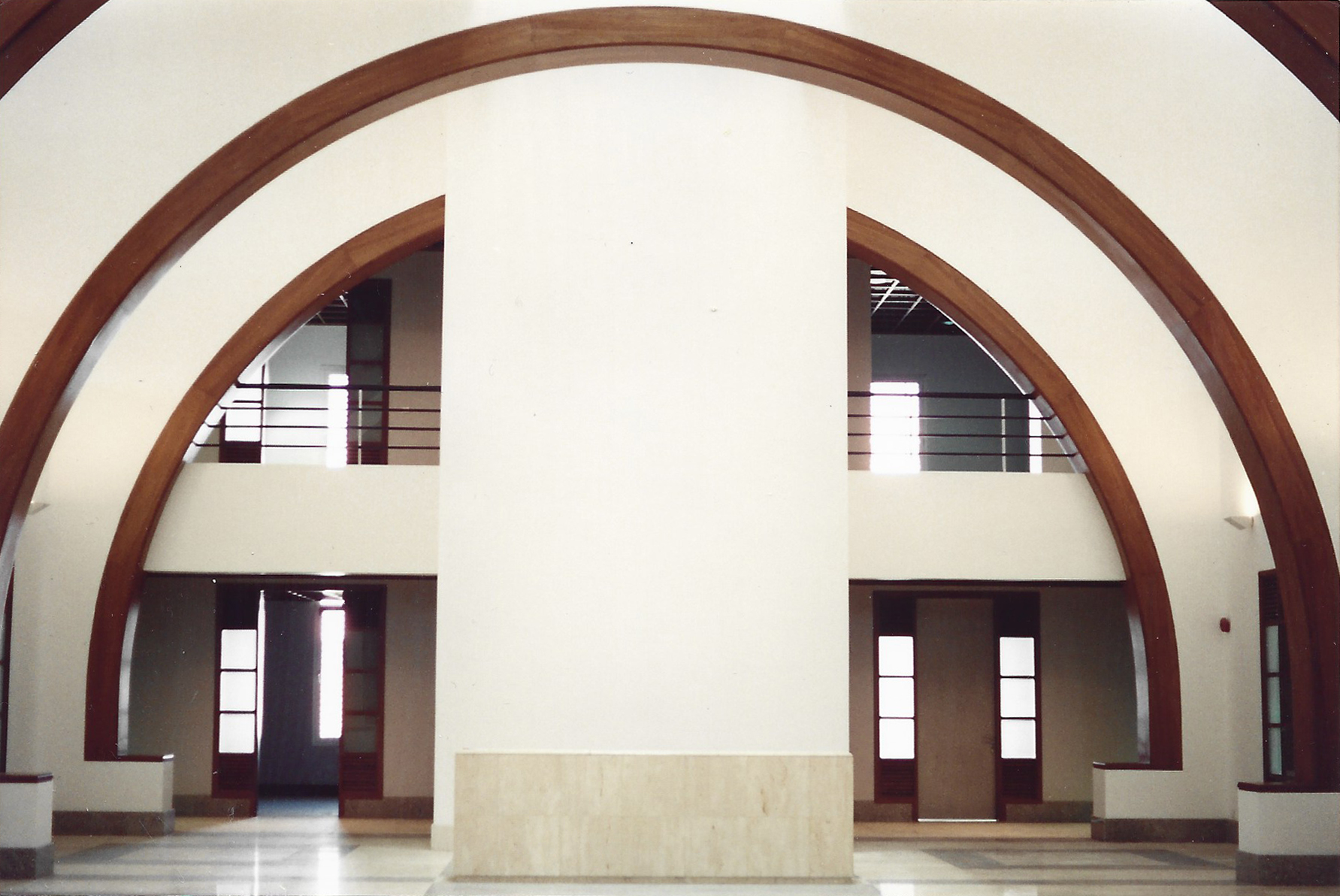
In the Lotus Building, Hamouié reinterprets this idea as a tall atrium at the heart of the plan. Like the courtyard, it organizes the building around a shared core and moderates its environment. Daylight enters from skylights above and is diffused by glass blocks, reducing glare and heat. The proportions are defined by a sequence of timber arches, which give structure and rhythm to the space while recalling the arcaded enclosures of Jeddah’s traditional buildings.
Here, the ribat’s shaded courtyard becomes a luminous interior. Its role remains unchanged — to provide circulation, climate control, and a central gathering space — but its expression is transformed for a modern institutional building.
Engineering the Environment
The traditional architecture of the Red Sea relied on simple but effective methods of environmental control. Thick coral stone walls absorbed heat, shaded courtyards created microclimates, and rawāshin filtered sunlight while allowing air to circulate. These passive systems produced comfort with minimal means, embedding climate response directly into the building’s fabric.
In the Lotus Building, Hamouié carried these lessons forward while expanding them through modern engineering. The atrium itself functions as a climatic device: warm air rises through its narrow vertical volume and escapes through the skylight, drawing cooler air into the surrounding spaces and maintaining natural ventilation. Hollow-core slabs were adapted into a cooling system, with chilled air passing through their voids and turning the structure into a cooled surface. This reduced air-conditioning demand by more than 60% year-round. The double-skin façade provided another layer of protection. By separating cladding from structure, it created a thermal break, shading the frame and stabilizing interior conditions.
The result is both low-tech and high-tech. The logic of vernacular comfort — mass, shade, air movement, and stack ventilation — is preserved, but enhanced through precise mechanical systems. In combining these approaches, the Lotus Building anticipated principles of sustainable design well before they became a formal discourse in the region.

A Prototype Ahead of Its Time
To read the Lotus Building today is to see a project that was astonishingly ahead of its time. Long before “sustainability” was formalized as a global discourse, here was a building that fused tradition and innovation to produce a work both rooted in its place and contemporary in its form. Its language was unmistakably local, yet its technologies rivalled the avant-garde architecture of the 1990s.
It is this duality that makes the Lotus Building exceptional: Swiss-like engineering discipline infused with the rootedness of Red Sea vernacular. This building is as moving in its historical grounding as it is impressive in its technical foresight. Nearly three decades on, it stands not only as a landmark of its era but as a lesson for ours — that true modernity emerges when we build upon memory, rather than start from a blank slate.
for further info:
http://www.diyar.com/index.aspx?page=projects&id=107
References:
- Hamouié, Mohamad. Lotus Building Personal Interview. Conducted by Reda Séjini, 19 February 2019. Jeddah, Saudi Arabia.
 madeinjeddah